I’ve been spending a bit of my time with the book “Attached” by Amir Levine & Rachel Heller.
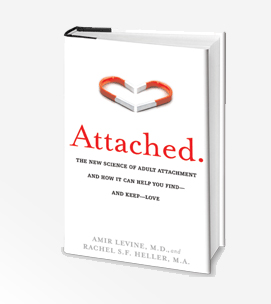
This book is giving me all kinds of feelings, and I want to talk about my experiences.
The book identifies three types of attachment: anxious, avoidant, and secure.
There’s a fun (heavy on the sarcasm) little quiz on the site that gives you some insight into your own personal attachment style. Take it yourself if curiosity has grabbed you.
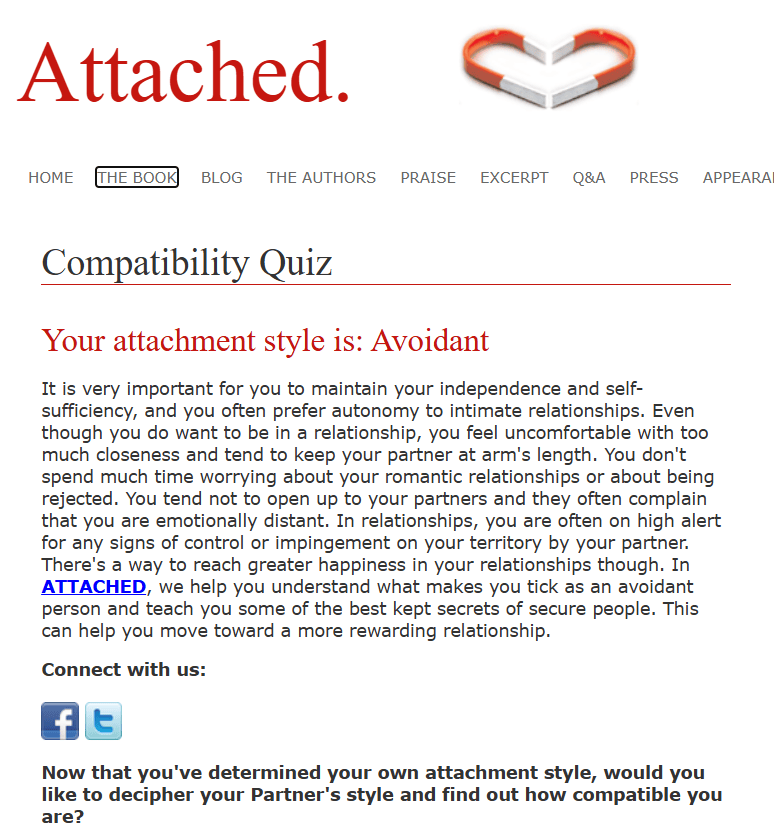
It wasn’t a surprise to me that I have an avoidant attachment style. I like attention but want it to be at my command. I love the idea of romance and happily-ever-after but can’t seem to tolerate it long-term.
Exactly one year ago, my attachment style was very different. I took a few quizzes back then too, out of curiosity. I was just beginning my understanding of attachment styles at that time, fresh out of a 16-year marriage that went up in flames.
Back then, my results indicated an anxious attachment style. I was suffocating my partners and potential partners with my anxious behaviors, such as:
- Needing constant connection
- Feeling lost without that connection
- Worrying endlessly about their silence (Did I say something wrong? Did I overshare? etc.)
- Spending hours re-reading conversations, looking for clues that they were leaving me
- Changing things about myself that I thought upset them, such as how I used my time, what I was thinking about, what types of entertainment I consumed, and even my opinion about my own worthiness.
- Emotional roller coasters depending on my partner’s mood/attitude/behaviors. If they were calm, I was calm. If they were agitated, I was agitated, etc. My moods were less dictated by my own experiences and more by my partner’s needs and comfort level.
I’ve cried into my pillow for hours when my partner went silent, only to learn later that they were in a meeting and hadn’t, in fact, been planning their escape from me.
I’ve also cried for hours because someone I cared very deeply about ghosted me. He came back, and we moved on. Later, I learned that these ghosting absences were exactly what I suspected early on…an avoidant attachment style showing itself. But my partner lied to me, claiming it was something else.
Little lies like these stack up over time. The avoidant digs themself a very deep hole they can never hope to get out of by coming up with excuses rather than facing the truth.
The truth, from where I stand, is that they were not ready for that relationship. They had not started the heavy work of fixing things about themselves that they didn’t break.
Little lies erode connection.
Little lies push a person like me to switch from an anxious attachment style to an avoidant attachment style.
Lies are not safe.
A partner who will lie to you about the small stuff will lie about the big stuff.
I should know.
I’ve been the liar. I’ve been the ghost.
The only way to stop the cycle of destruction is to understand it, which is why I picked up this book. There is a fantastic amount of information contained in this book about attachment, deep wounds, identifying triggers, and changing the way you see attachment.
One of the biggest takeaways for me from this book is the concept of the ledger and dropping it to have better relationships.
Somewhere around the ten-year mark in my first marriage, we started an unspoken game of “keeping score”. I would fail to do something he needed me to do because he wasn’t emotionally available to me when I needed him. He would give me the silent treatment for a night because I was intentionally quiet when he wanted me to speak.
But here’s the thing about those injuries…
I wouldn’t tell him that I needed him to emotionally support me. I left him guessing, assuming that he could read the room well enough to know what I needed. As a person with Borderline Personality Disorder (BPD – we didn’t have a confirmation at the time, but there had been a prior diagnosis that I rejected in classic BPD style), my behaviors and moods shift often, leaving him to guess what I needed was setting us both up for catastrophic failures.
Sometimes, it wasn’t that I didn’t want to speak. I wanted to, but the words wouldn’t come out. I didn’t know at the time that I am autistic, and one of my biggest roadblocks is that during periods of heightened emotions, I lose the ability to speak. Sometimes I can use words, but they don’t come out the way I want them to. So I attempted to minimize that damage by not using any words, which only leads to more confusion and hurt feelings.
This is still a very real problem for me, and one of the key reasons why I am opting out of the dating game for a very long time.
I was raised in a house with lots of boys. I have two full brothers, two stepbrothers on my dad’s side, and a handful of stepsiblings on my mother’s side (there was a semi-rotating cast in my childhood)
The important part is that I was ALWAYS surrounded by boys. I was also an athlete. Competition was my entire existence. In my family, both close and extended, the only way to get attention was to be worthy of attention. Being part of a winning sports team, getting a trophy at the State Debate Tournament, having a poem published as “Best in the State” in 5th grade, being so good at Trivial Pursuit that NOBODY will play against me after 2 or 3 games, etc.
So in relationships now as an adult, when I feel out of control, I find myself turning it into a competition. An imaginary scoreboard goes up in the air, and somewhere inside my mind, a gremlin starts taking notes. Since I have so much trauma surrounding men abusing me, that gremlin always leans heavily in favor of the female on the board. The deck is stacked before anybody sits down at the table.
Every slight, such as failing to clean up dirty socks from the living room floor or expecting me to take care of the animals but telling everyone it’s specifically “your” dog or cat, every time my partner said they’d take care of dinner but left me making all the decisions, every short temper, bad mood, attitude, or otherwise unpleasant reaction, an imaginary tally mark was made in the compendium that was titled “Who’s the better partner?”
When I was upset and not getting the attention I craved, I stewed over the scoreboard. I dissected interactions and rehashed conflicts that had been resolved, dragging them through the mud over and over again as I wrung out every single failure and documented it in tally-mark form.
I dissected and analyzed the relationships more than actually living with them.
When the anxious wounds get too deep, the pendulum swings the other way. A soft but persistent voice in the back of my mind whispers, “It’s time to hide…it’s time to disappear…it’s time to remove everything that demands more of your time than you are capable of paying.”
Relationships are destroyed. Friendships are ruined. Schedules have to be cleared and rewritten. Habits are changed to align with the new way of life. Everything about the safe space has to be reevaluated and changed.
After a time, the sting starts to fade, and calmness sets in.
A desire for change.
A sparkle in the air settles as my mind can finally see what it was avoiding the whole time.
Yes, I’m an avoidant at times.
Yes, I’m anxiously attached at times.
Yes, I have some relationships that are entirely secure attachments.
My attachment style with each person is entirely determined by the interactions between myself and the person.
My children- my securest attachments. I do not falter on these. Even if I don’t speak to them for months, I know that they will come to me when they need me, and if I need them, they will answer. Children, especially in the young adult stage, need to feel safe to call home but also safe enough to explore the world untethered. I hope that through all my mistakes as a parent, they know that my attempts were only ever to give them the best life I knew how to, and as I have learned better ways, we’ve shifted to make life more worthwhile.
Most of my friendships are secure attachments. We don’t talk every day, sometimes not for weeks at a time. But when we reconnect, it’s like no distance or time has passed. When there is a problem, we address it in roundtable fashion until the problem is solved.
Relationships where support is required are where this all falls apart. My parents, as my primary caregivers, were my first source of anxious/avoidant swinging, and that will continue long after they are both gone.
Romantic partners are another area where I can never seem to get it right. I try so hard to be what they want, only to become someone I am unable to maintain long-term. The swings cause me to be a bad partner.
That is the story of my relationship history. Bad partner to other bad partners. When your taste in men reads like a trigger warning listing, you can’t expect quiet Sunday mornings and a regulated nervous system…
Just a few of their proven offenses: (For entertainment purposes only, not currently seeking felon boyfriend applications)
- Petty Theft
- Grand Theft
- Domestic Violence
- Battery
- Sexual Assualt
- Physical Assualt
- Sexual Assault of a Minor
- Criminal Damage to Property
- Stalking
- Harrassment
- Intimidation
- DARVO
- Strangulation
- Coercion
- Blackmail
- Cyber Stalking and Bullying
- Criminal Possession
- Bail Jumping
- And probably at least a dozen offenses I’ve forgotten or that my brain has blocked entirely.
As I sit with all of this information, I reflect it back to the lessons in this book. If a relationship requires a scoreboard, it’s already over. If a relationship cannot respect boundaries, it’s over. If a relationship makes me feel like my life is not worth living, it’s over.
Perhaps that’s the avoidant talking, but this is a hard rule moving forward.
If a partner gives me the ick, I’m gonna be walking away.
Knowing how much I value my time, my ability to do what I want when I want to, it only makes sense to spend this next season of my life rebuilding me.
I’ve got some very exciting things in the works coming up in the next few months, and I’ll share more as I get details ironed out. I’m going to be spending my time devouring books, finishing my thesis novel, and getting back into the swing of living the life of a writer, something I put on hold when my mental health got bad. It’s time to get back up, dust off my jeans, and rebuild brick-by-brick.

Have you taken an attachment style quiz? If so, how did you feel about your results? I’d love to continue this conversation in the comments!
Until Next Time,
Cathy Marie Welton


Leave a Reply